 HackingPassion.com
Why a Vpn Is Not Privacy
Ethical Hacking Complete Course Zero to Expert
Hack like black hat hackers. Penetration testing, Kali Linux, WiFi and web hacking, and the hacker mindset behind it.
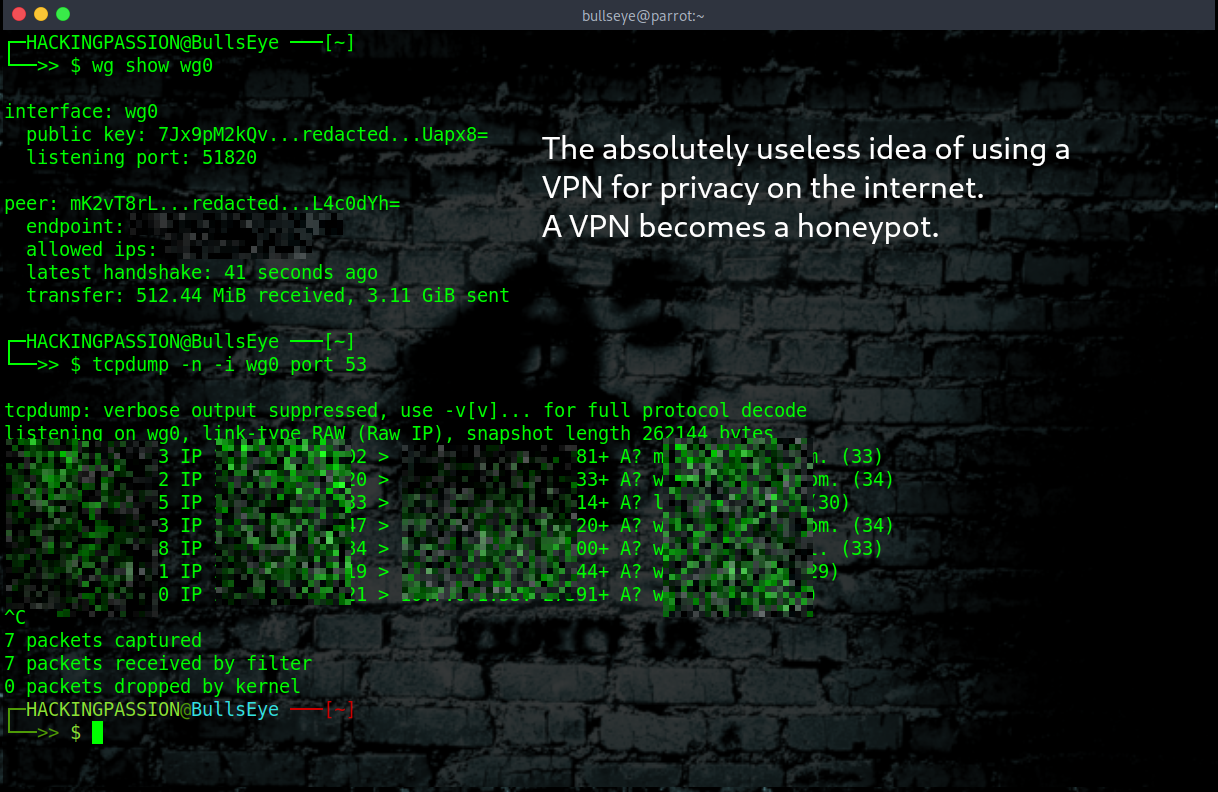
→ Take the full courseThe absolutely useless idea of using a VPN for privacy on the internet. A VPN becomes a honeypot. 🧐
Yes, you read that right.
First, what a VPN does. You install an app. The app builds an encrypted tunnel from your device to a server owned by the VPN company. Your traffic travels through that tunnel, and from the VPN server it continues to the sites you visit. The sites see the address of the VPN server instead of your home address. Your internet provider sees an encrypted stream to one server and nothing more.
That sounds like privacy. It is not. You move your data from your internet provider to a VPN company. Your provider no longer sees which sites you connect to. The VPN operator sees it instead. You are not solving a problem. You are moving it.
Nearly all web traffic is encrypted with HTTPS these days. Your provider could not read your messages or your passwords anyway. What it sees is which sites you connect to, when, and how much data flows. That trail has a name: metadata. A VPN takes that information away from your provider and hands it to a company you know far less about. And you created an account there, with your email address and payment details attached.
There is a sharper way to see this. The tunnel encrypts your traffic against everyone outside it, and the VPN is the point where the tunnel ends, so it reads what your provider could not. Without a VPN, no single party on the network path has the full picture. Your provider knows who you are and which servers you reach, but not what you do there. Each site knows what you do on it, but not who you are or where else you go. The knowledge is split, and neither half is complete. A VPN puts both halves in one place. On one side it has your real address. On the other side it has every site you open. In the same server, at the same time, linked. You did not remove a watcher. You built a new one that sees more than your provider ever could, and it is the one you are paying.
Whether that company writes anything down is a choice you cannot check from the outside. No logs is a promise, not something built into the technology. The traffic passes through their servers either way, and whoever controls those servers can read the metadata, log it, sell it, or hand it over.
So why do so many VPN companies exist, and why is the advertising everywhere? Because it is easy money. A VPN company sets up a server farm and routes traffic through it. That is the entire product. There is no complicated service behind it, just accounts, bandwidth and a monthly subscription. The costs are low and the margins are enormous. The product is not privacy. The product is the story that you need one.
And there is a second problem, built into the business itself. A VPN company gathers the traffic of people who care about hiding it. Ordinary users stay with their provider. The careful ones gather at a handful of VPN companies, together with their names, email addresses and payment details. That pile of data is valuable, to advertisers, to data brokers, to intelligence services and to criminals. You are not stepping out of view. You are joining a smaller, more interesting group.
In security work, a system that looks like a normal target but exists to watch whoever comes in is called a honeypot. A VPN becomes one in three ways. It can be run or taken over by the people watching you. It can be legally required to hand over what it sees. Or it can be built so badly that outsiders read along. In all three cases the service keeps working. The tunnel connects, the sites load, the subscription renews. From the inside, a honeypot looks exactly like the privacy tool you paid for. That is the whole point of one. Facebook did exactly that with Onavo, a free VPN it gave away as a privacy app while using it to watch what its users did online. A privacy service can be a surveillance operation, and from the inside you cannot tell the difference.
The promise has been tested before, and the list of providers that broke it is not short:
- → PureVPN advertised no logs, then handed connection timestamps to the FBI. The FBI matched the moment a VPN account connected with the moment the suspect’s accounts were used, and the customer came into view. That trick is called a
time-correlation attack. No browsing history needed. - → IPVanish claimed a zero-logs policy while it recorded user activity, and handed a customer’s name, email address and home IP to investigators.
- → HideMyAss sold anonymous surfing, then handed over connection records that got a user convicted.
- → UFO VPN and six sister brands marketed no-logs policies while an open server exposed over a terabyte of logs, including plaintext passwords, from as many as 20 million users.
Different companies, different countries, the same pattern. The policy said one thing, the servers said another.
A no-logs claim can be true. In April 2025, a court in Athens dismissed the case against the founder of Windscribe. A server in Finland had been used in an attack on a Greek system, and instead of asking the company for data, the authorities put the founder on trial in person. The case fell apart for a simple reason: there were no logs to hand over, so there was nothing to place him at the scene. Proof under pressure exists. It is rare.
I have never used a commercial VPN and I have never bought one. It is also something I am never going to do. As you have read, in most cases it is pointless.
There are situations where a VPN earns its place. It was invented for one of them: reaching a private network from the outside. An employee working from home connects to the company network through a corporate VPN, and for that job the technology works as intended.
- → Censorship and access blocks. In countries that block sites and apps, a VPN is a way through, as long as the VPN itself is not blocked.
- → Geo-restrictions. Watching a streaming library from another country works, until the platform detects the VPN address and blocks it.
- → Peer-to-peer games. On dedicated game servers, other players do not see your address. Games like GTA Online connect players directly to each other, and there another player can run a
packet sniffer, a tool that records the traffic arriving at his own machine, and read your home IP. Streamers have been knocked offline that way.
That list is about access, and about choosing who sees your traffic. Privacy is not on it.
What to do:
- → Free VPN app on your phone: remove it. The operator pays the server bills with your data or your bandwidth.
- → Want one for privacy: ignore the marketing and look for proof under pressure. Court records, not review stars.
- → Looking for anonymity: a VPN is the wrong tool.
How traffic really moves through a network, what a VPN can and cannot do, and how real anonymity works with
Tor,proxychains,DNSand traffic obfuscation. You start at zero, no Linux or hacking background needed, and you finish able to test systems yourself with the same tools used in professional penetration testing. That is a skill you can build a career on. → Join my complete ethical hacking course
Hacking is not a hobby but a way of life.
Stay updated
Get the latest posts in your inbox every week. Ethical hacking, security news, tutorials, and everything that catches my attention. If that sounds useful, drop your email below.