 HackingPassion.com
FBI NCIC Database Police Search at Traffic Stops Reportedly Hacked With 19.3 Million Records Inside
Ethical Hacking Complete Course Zero to Expert
Hack like black hat hackers. Penetration testing, Kali Linux, WiFi and web hacking, and the hacker mindset behind it.
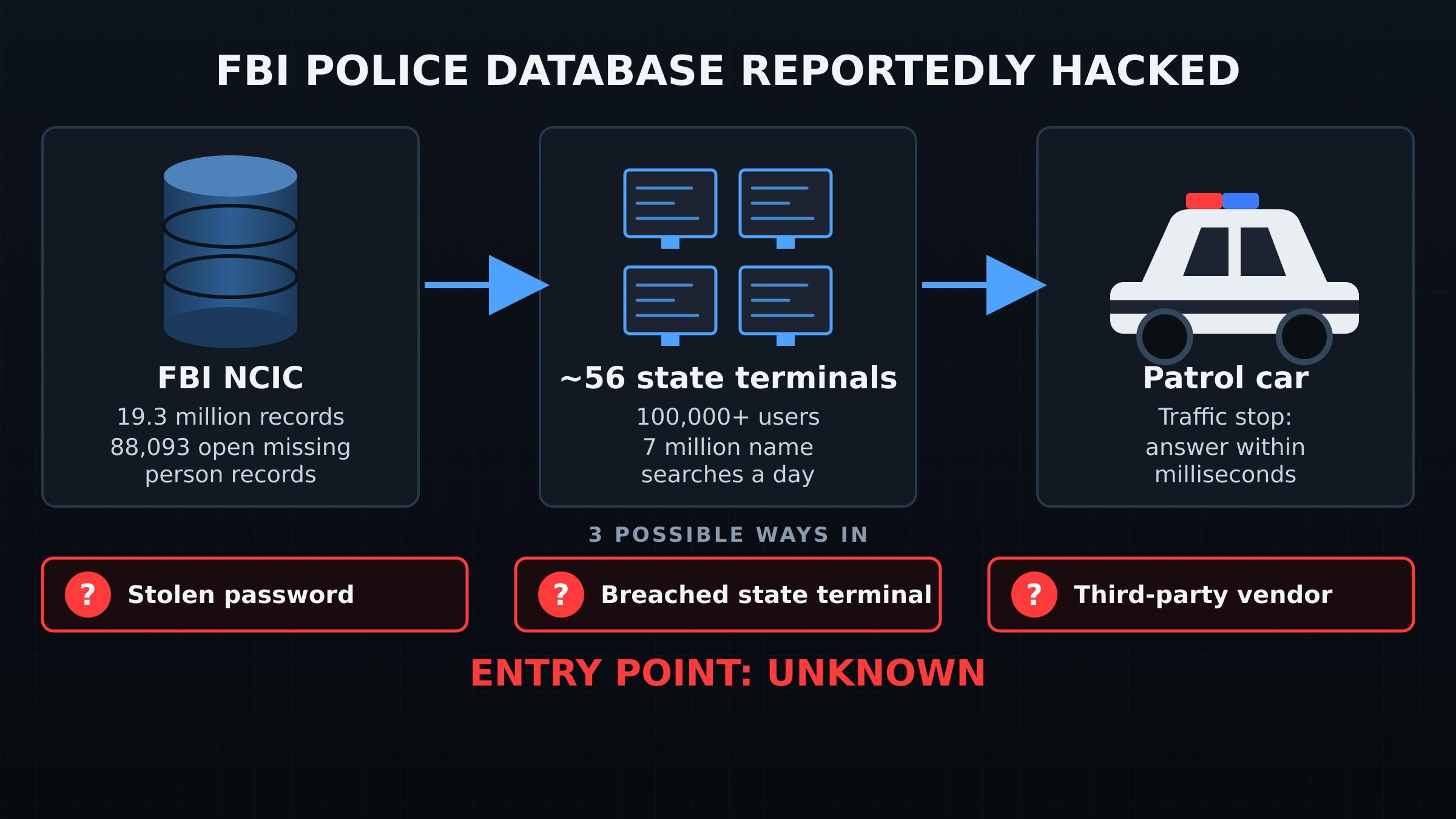
→ Take the full courseHackers reportedly got into the FBI database police search 7 million times a day: 19.3 million records on fugitives and stolen guns. Missing children are in it too. The FBI has not said how, or since when.
The database is called the National Crime Information Center, or NCIC. When a police officer in the US stops a car and runs the driver’s name or the license plate, the answer comes from here, within milliseconds. That answer shows the officer a warrant for the driver, a report that the car is stolen, or a court order that keeps this person away from someone. According to the FBI, the system serves more than 100,000 criminal justice and law enforcement partners, 24 hours a day, 365 days a year.
# TL;DR
On Friday, November 20, a US news network reported that the FBI was investigating a break-in into that system. It cited two people briefed on the investigation. The next morning, three sources told another network that hackers had breached NCIC, and that the FBI was trying to find out where they got in. A law enforcement source confirmed the hack to a third network.
The FBI itself has not confirmed any of it. It declined to comment to some outlets and did not respond to others. What is known about the break-in comes from people who spoke without giving their names. On Saturday, the president also said that NCIC was targeted in a hack, without giving details. That is how this post treats it: reported, not confirmed.
The news came after a series of outages at US banks, the NSA and the air traffic control system of the FAA. Officials of the administration blamed those on routine upgrades and fixes, and there was no immediate sign that the FBI incident was related.
The FBI started NCIC in 1967 with five files and 356,784 records. In the beginning, 15 state and city computers were connected to it. Within four years, the system reached all 50 states.
Today NCIC has 22 files. Seven are about property: stolen articles, boats, guns, license plates, securities, vehicles, and vehicle and boat parts. The other 15 are about people:
→ Wanted Person and Foreign Fugitive
→ Missing Person and Unidentified Person
→ Protection Order, and Extreme Risk Protection Order, the court order that temporarily stops someone from buying or owning a gun
→ the National Sex Offender Registry
→ Identity Theft
→ Gang, Violent Person and Immigration Violator
→ NICS Denied Transaction, for people who were refused when they tried to buy a gun
→ Threat Screening Center, Protective Interest and Supervised Release
Police departments and other agencies across the country put those records in, and they have to change and remove their own records as well. The FBI’s Criminal Justice Information Services Division, CJIS, keeps them. In its review of fiscal year 2025, the FBI wrote that the number of records in NCIC grew each month, to an all-time high of over 19.3 million. The system was available 99.8 percent of the time.
The same review gives an example of how NCIC is used. In 2024, officers of US Customs and Border Protection at a border crossing came across a vehicle that NCIC flagged as stolen. It had been taken in a midwestern state, and according to the authorities, the driver had come from there to the border in it. NCIC also showed an active felony warrant from a western state, for the alleged armed robbery of a car during a meeting set up through an online marketplace. The officers checked both records in NCIC and took the driver into custody.
Then there are the missing. In 2025, agencies entered 498,038 missing person records into NCIC, and 323,767 of them were children under 18. In the same year, agencies took 443,390 missing person records out again, by canceling or clearing them. At the end of 2025, 88,093 were still open. Next to them sit 8,509 records of people whose name is unknown, and 8,253 of those people are dead. 218 are alive and unable to say who they are, such as a person with amnesia or a baby.
Across 2025, agencies searched NCIC by name 2,674,486,640 times. That is more than 7 million name searches a day.
The FBI has not said what happened inside. It has not said how the attackers got in, who they are, or what they copied.
A retired FBI supervisory special agent told one network that investigators will go through IP logs and metadata to find the entry point. He named three possible ways in: a compromised password of one of the more than 100,000 users, a breached state terminal, or a third-party vendor. According to him, roughly 56 state terminals pass the data on to hundreds of thousands of computers in patrol cars. He also said there was no indication yet that records were altered or that the system was down.
The FBI lists its own protections for the system. It encrypts the information and makes each agency prove who it is before it gets access. Each agency has to check its own records regularly, and periodic audits check that agencies follow the security rules.
A former FBI official who led cybercrime investigations said he worries about two things: what the attackers could read, and whether they could make the information officers rely on wrong.
The FBI’s own rules show how much depends on a correct record. When NCIC gives a hit, a match on a name or a plate, the police agency first has to confirm that the record is accurate and up to date. Only then can officers act on it.
One of the 15 person files is the Violent Person File. It holds people with earlier violent convictions who have said they intend to commit violence against police officers or others who work in criminal justice. According to the FBI, officers who get a hit in that file can approach the person more carefully.
The Violent Person File grew by more than 93,000 records in fiscal year 2025. In that same year, an advisory board of police and justice officials recommended a change to the FBI Director. NCIC should show results from this file first, before the Wanted Person File and the rest.
So far, no report says that a record was changed. The FBI has not said anything about it either way.
On Thursday, November 19, after FBI officials had learned of the incident, FBI Director Kash Patel was on television talking about the bureau’s cybersecurity work. According to the network that first reported the hack, he spoke about an operation that had ended months earlier as if it was still running. “Other administrations could have made these updates, but they didn’t,” he said.
Two days later, President Trump was asked about the hack in a phone interview. “I will say that it’s not good. I don’t like that,” he said. Then he suggested, without evidence, that it might bring out things about the investigation into Russian interference in the 2016 election. He also mentioned his 2019 phone call with the president of Ukraine.
NCIC holds warrants, missing people, stolen property and court orders. One of the networks that covered the interview pointed out that NCIC would not hold information on those investigations.
This is the third FBI system reported hit this year.
In March, the FBI said it was investigating “suspicious activities” on an internal system that holds sensitive information about surveillance operations and investigations. In a notice to Congress, the Justice Department later called it a major incident under FISMA, the US law that sets the security rules for federal computer systems.
In September, a group called ShinyHunters said it had broken into FBIJobs.gov, the FBI’s recruitment website. It claimed data on almost all FBI agents and on people who had applied for a job there. The FBI said it was aware of claims of “unauthorized activity affecting FBIjobs.gov” and was investigating. The group gave samples of 5,000 agent records to journalists, who confirmed they were genuine.
On October 8, the FBI arrested a Canadian cybersecurity executive in its investigation into the group. The complaint in his case is sealed, so what he is accused of doing is not public.
Nothing so far connects the NCIC break-in to that group, and no group has claimed it.
NCIC has been broken into before. On April 5, 2001, the director of the FBI’s National Infrastructure Protection Center at the time testified before a committee of the US House of Representatives. He talked about a group the FBI called the Phonemasters. According to his testimony, they got into the computer systems of MCI, Sprint, AT&T and Equifax, “and even the National Crime Information Center.”
Their method needed very little technology. They went through trash for old phone books and technical manuals. They used what they found to trick employees into giving up their login names and passwords, and then they logged in with those.
One member downloaded thousands of calling card numbers from one of those phone companies and sold them to someone in Canada. From there the numbers went to Ohio, then to Switzerland, and ended up with organized crime groups in Italy. In September 1999, two of the group’s leaders were sentenced after pleading guilty: one to two years in prison, the other to 41 months.
NCIC was also in the middle of changes when the November break-in happened. In its review of fiscal year 2025, the FBI wrote that NCIC was in extensive testing before its final move to the cloud in fiscal year 2026. The division that runs it had already moved 95 percent of its IT systems to the cloud.
Access to NCIC grew as well. The FBI wrote that access had historically been limited to criminal justice agencies that meet a strict set of requirements. In fiscal year 2025, more than 37,000 licensed gun dealers got a way to check firearm serial numbers against the stolen gun records in NCIC. They do that through a web portal of the FBI’s background check system for gun buyers. When there is a match, the agency that entered the record gets a notice.
None of this explains how the attackers got in. The FBI has not said, and these changes may have nothing to do with it.
In cybersecurity, attribution is one of the hardest problems. IP addresses can be spoofed. Tools can be shared. What is known today is small: the FBI is investigating a break-in into NCIC, FBI officials knew about it by Thursday, November 19, and the FBI has not said what was taken or changed. Nothing public says yet who is behind it.
What stays open is the question an officer has at the side of the road: whether the record that comes back on the screen is still right. For the families behind 88,093 open missing person records, it is the same question.
Want to see how much an attacker can find before touching a system? Run Sherlock on your own username and count what comes back.
My Ethical Hacking Complete Course Zero to Expert takes you there step by step: reconnaissance, scanning, exploitation and traffic analysis, hands-on, from your first day with no Linux or hacking background.
→ Join my complete ethical hacking course
Hacking is not a hobby but a way of life.
Sources:
FBI: National Crime Information Center | FBI CJIS 2025 Year in Review | FBI 2025 NCIC Missing Person and Unidentified Person Statistics | FBI Testimony on Intrusions into Government Computer Networks, 2001 | US Department of Justice: Phone Masters Ringleaders Sentenced, 1999
Stay updated
Get the latest posts in your inbox every week. Ethical hacking, security news, tutorials, and everything that catches my attention. If that sounds useful, drop your email below.