 HackingPassion.com
BYOD Hackers Locked a Trauma Center's Computers, Then Offered Patients 2,500 Dollars
Ethical Hacking Complete Course Zero to Expert
Hack like black hat hackers. Penetration testing, Kali Linux, WiFi and web hacking, and the hacker mindset behind it.
→ Take the full courseFor two hours, New Mexico’s only trauma center sent its ambulances to other hospitals. Its own computers were reading a ransom demand out loud. The next day the hackers said sorry, and kept the data.
# TL;DR
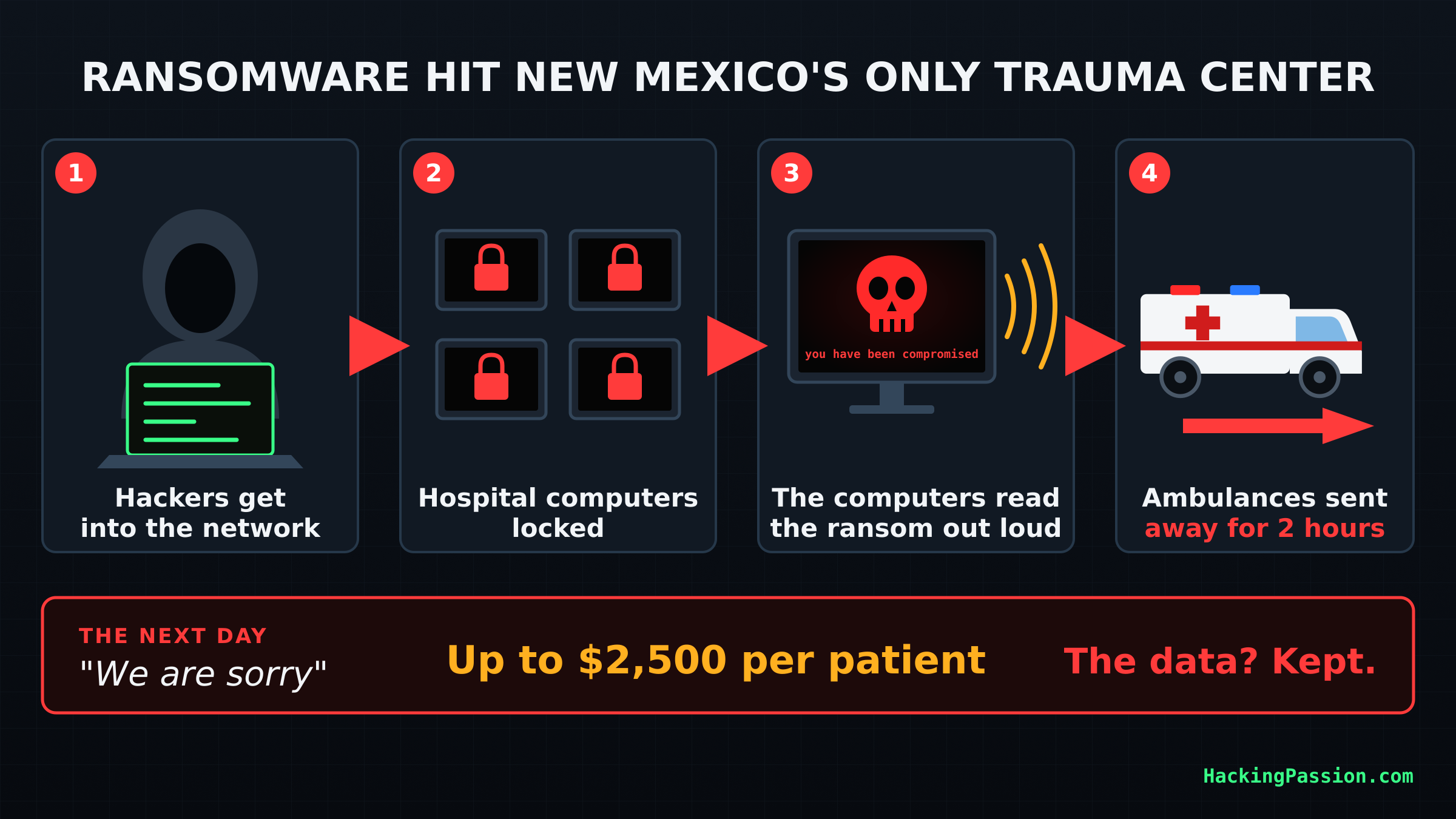
It started on a Monday morning, October 26, at the university hospital in Albuquerque. Around 11 o’clock, the hospital’s IT team saw something on the network that did not belong there and started shutting it out. A little after noon, the staff got an alert to unplug their desktops and switch off WiFi on their phones.
Then the computers started to talk.
A computer voice, the flat kind that text-to-speech software makes, came out of the machines inside the hospital. A local TV station got part of the recording. The voice said the attackers had the data of the students and employees, their Social Security numbers, their private documents and their email. It told the people in charge to get in touch right away, through an encrypted chat app called Session, or the university would be taken down so far it could no longer function. On the screens, a red skull appeared with the words “Oh no, you have been compromised.” A doctor at the hospital told the student newspaper that the message played on their own computer.
This hospital is the only Level 1 trauma center in New Mexico. Level 1 is the highest level of trauma care, the hospital where the most badly injured patients are taken. The same health system runs the only burn unit and the only children’s hospital in the state, and it takes care of a large part of the people in New Mexico who have no health insurance. In a normal year, it handles around 900,000 outpatient visits and 100,000 visits to the emergency room.
From 12:30 to 2:30 that afternoon, the hospital sent its ambulances to other hospitals in Albuquerque and Santa Fe. For those two hours, a patient in New Mexico with the worst kind of injury had no emergency room in the state that could take them. The hospital cancelled the appointments at more than 30 clinics for the rest of the day and stopped the outpatient surgeries. Patients were told to stay home, to call 911 if it was an emergency, and to wait with the rest.
That same day, the attackers put the university on their website.
They call themselves BYOD. Like many ransomware groups, they run a leak site, a website on the Tor network where they list the organizations they hit and publish the stolen data of the ones that do not pay. Their post about the university was loud. It claimed 36,000 computers and both of the university’s Active Directory networks, one for the campus and one for the hospital. Active Directory is how a big organization decides who you are when you log in, and which computers and files you may use. The post also claimed the cloud version of that system, two Oracle databases, the payroll, the student records and the internal email. It would come down, the group wrote, once the university got in touch.
The hospital tells a much smaller story. Its own investigation found that some of the computers people work on were hit, but that the attackers did not get into the core systems or the servers. Two days later, some employees still had to leave their computers off.
Then, on the Tuesday, the hackers changed their tone.
In a post titled “UPDATE: UNM,” the group wrote that it had not known those machines were helping patients while they were being treated. It offered the key for the remaining locked computers for free, but only on the hospital side. The campus stayed locked.
In brackets, the group added that it would have kept the hospital locked too if those machines had only held appointments, patient information and research data. So the apology covered the machines that helped patients during treatment. And then it spoke to the patients themselves. A patient who was affected could send proof, and the group would pay them up to 2,500 dollars each, for the inconvenience. It wrote that it was sorry, that it had morals and a heart, and that it was not a villain. In the same post, it wrote that it would keep the data, and that it would go on holding companies responsible for bad security.
That free key gave something away. You can only hand out a key for computers you have locked.
Look at that 2,500 dollar offer from the patient’s side. To get the money, you would have to prove who you are, to the people who took your medical records.
The hospital answered on Wednesday. Without naming the group, it said it had made no deals with the people behind the attack. It warned that they might now go after patients, students and employees one by one, with false offers of payment or compensation. It told them not to answer, and to keep the message and report it to the FBI’s Internet Crime Complaint Center.
Two weeks later, the same voice turned up in Nashville, Tennessee.
On Monday, November 9, around 8:30 in the morning, Vanderbilt University started fighting off an attack. The university has about 14,000 students. At 10:45, it sent a message to its students and staff: shut down your university devices, get off the campus WiFi, and watch out for these signs:
→ pop-ups and security warnings that come out of nowhere
→ files that move, change or disappear
→ programs you did not install
→ a request to type in your password or approve a login that you did not start yourself
A professor’s laptop played the voice in the middle of a class, the university’s own student newspaper reported, and a video of it went online. This is what it said:
“You have been compromised by BYOD. We suggest you reach out to us as soon as possible. Instructions have been placed on your desktop. Failure to communicate will result in this estate being brought to the ground completely. Make the right choice or rot with the wrong one.”
On the desktop sat a file called README_BYOD_31.txt with the instructions. On their leak site, the group claims it locked the university’s databases and took over the domain controller, the server that holds the accounts and passwords for the network. It also claims research data and more than one million Social Security numbers. The university has not confirmed any of that.
It has said how far from over this is. On November 19, ten days in, the university still called it an ongoing cyberattack. OneDrive, SharePoint, Teams and Copilot were still switched off. The files in Box came back that day, set back to how they were right before 8:30 on November 9. The first step to bring OneDrive back is planned for the first week of December. So many laptops were hit that the university emails their owners in daily batches, and for desktop computers and shared machines it is still working on a fix.
The group claims far more than two schools. TrendAI Research counted at least nine organizations in the five weeks between October 5 and November 9, and the researchers keep apart what the victims confirmed and what the group claims. Here is what the group put on its leak site, and what it says it has:
→ October 5: Trump Mobile. The names, home addresses, email addresses, phone numbers and order details of 3,615 customers went online, including people who never finished signing up. People in the data confirmed it was theirs. A member of the group later claimed they got in through malware on the computer of an employee at the mobile carrier that runs the service.
→ October 13: Decorolala, a Canadian home goods shop. The group claims 60,544 customers, with home addresses down to the exact coordinates, and the UPS tracking links of their orders. According to the group, those links include delivery photos of the outside of the customers’ houses.
→ November 2: Michigan State University. The group claims the personal data of 1.03 million current and former students, plus their current and old passwords. On November 16, it posted that data for download.
→ November 4: IHG Hotels & Resorts, the company behind Holiday Inn, Crowne Plaza and Staybridge Suites. The group claims guest names, billing addresses, room charges, stay dates and the loyalty program data. It also mocked the company for a directory password of 123, and claims full access to CyberArk, the vault where the company keeps its most powerful passwords. The next day came a post titled “First and Final Warning,” with sample files.
→ November 9: the Texas Health and Human Services Commission, the agency that runs Medicaid and food assistance in the state. The group claims data on 2 million Texans, including health, food aid and bank details. A “final warning” with a sample followed on November 16.
→ November 10: Toyota in Japan. The group claims names, email addresses, home addresses, phone numbers, dates of birth and access to kiosk devices.
The hotel chain, the carmaker and the Texas agency have not confirmed an incident, and the agency told reporters the claims are unverified.
One group hit a trauma center and two universities in five weeks, and claims a hotel chain and a state agency. A known software flaw gets an official number, a CVE. No CVE has been tied to a BYOD attack. That also means there is no patch you can install against this group.
The trail points to logins. The university in Michigan saw suspicious activity that looked like stolen passwords. On October 1, it made the holders of a university account pick a new password of at least 15 characters. A month later, the group listed it. And then there is that password of 123 at the hotel chain, if the group is telling the truth.
That same hotel company’s password vault came up four years ago. In 2022, the hackers behind an earlier attack on it said in an interview that they got into the vault with the password Qwerty1234, and that the login for it was visible to 200,000 staff. The company disputed that its vault was insecure.
Ransomware.live, a site that tracks ransomware groups, also shows data on infostealers: small programs that copy the saved passwords and login cookies out of a browser and send them to the attacker. That data comes from Hudson Rock, a company that follows them. For the BYOD victims with a known web domain, 100 percent had staff or users whose logins were stolen this way. For that university in Michigan alone, the tracker counts 624 employees and 3,674 users.
With a working password, the attacker logs in as that person. From there, the group keeps naming the same targets: Active Directory, the domain controller, and Group Policy, the part of Windows an administrator uses to send settings and scripts to the computers in a network from one place. Get control of that, and you can push your own program to those computers in one go. That is how many ransomware groups lock an organization in one step.
Access like that also fits the voice. To play sound on many computers at once, the attackers had to be able to run their own code on many computers at once. The researchers say that matches the wide access BYOD claims, without proving it.
The warning list from Nashville points the same way. A login request you did not start and permissions on your cloud files that suddenly changed are the signs of someone walking around with a stolen account.
BYOD first showed up in September 2026. On its leak site it calls its work “pentesting,” meant to expose bad security and to hold accountable the organizations that see their customers as a number. The name is the same as the IT term “bring your own device,” but the group has never explained it.
In cybersecurity, attribution is one of the hardest problems. What we know for sure is what the victims confirmed and what the group posted. Who is behind BYOD, nothing public answers yet.
In Albuquerque, the ambulances were back at 2:30 that Monday afternoon. By Tuesday afternoon, the hospital reported its critical systems back online and the clinics open again. The hospital says it did not pay. At the end of October, it was still waiting for the forensic results to know whether patient data was taken. In Nashville, getting the systems back will take weeks.
What you can do:
→ Someone contacts you and says they have your data, with a threat or with an offer of money. Do not answer, do not click and do not pay. Keep the message and report it. In the US that is IC3.gov.
→ Never approve a login request on your phone that you did not start yourself. A string of those prompts means someone already has your password.
Want to see what one stolen login would let an attacker reach on your own network? Map your home network with Nmap from a second machine and find out.
My Ethical Hacking Complete Course Zero to Expert takes you there step by step: reconnaissance, scanning, exploitation and traffic analysis, hands-on, from your first day with no Linux or hacking background.
→ Join my complete ethical hacking course
Hacking is not a hobby but a way of life.
Sources:
UNM Health Sciences Center | Vanderbilt University | TrendAI Research | Ransomware.live
Stay updated
Get the latest posts in your inbox every week. Ethical hacking, security news, tutorials, and everything that catches my attention. If that sounds useful, drop your email below.